Accord Quartet
About
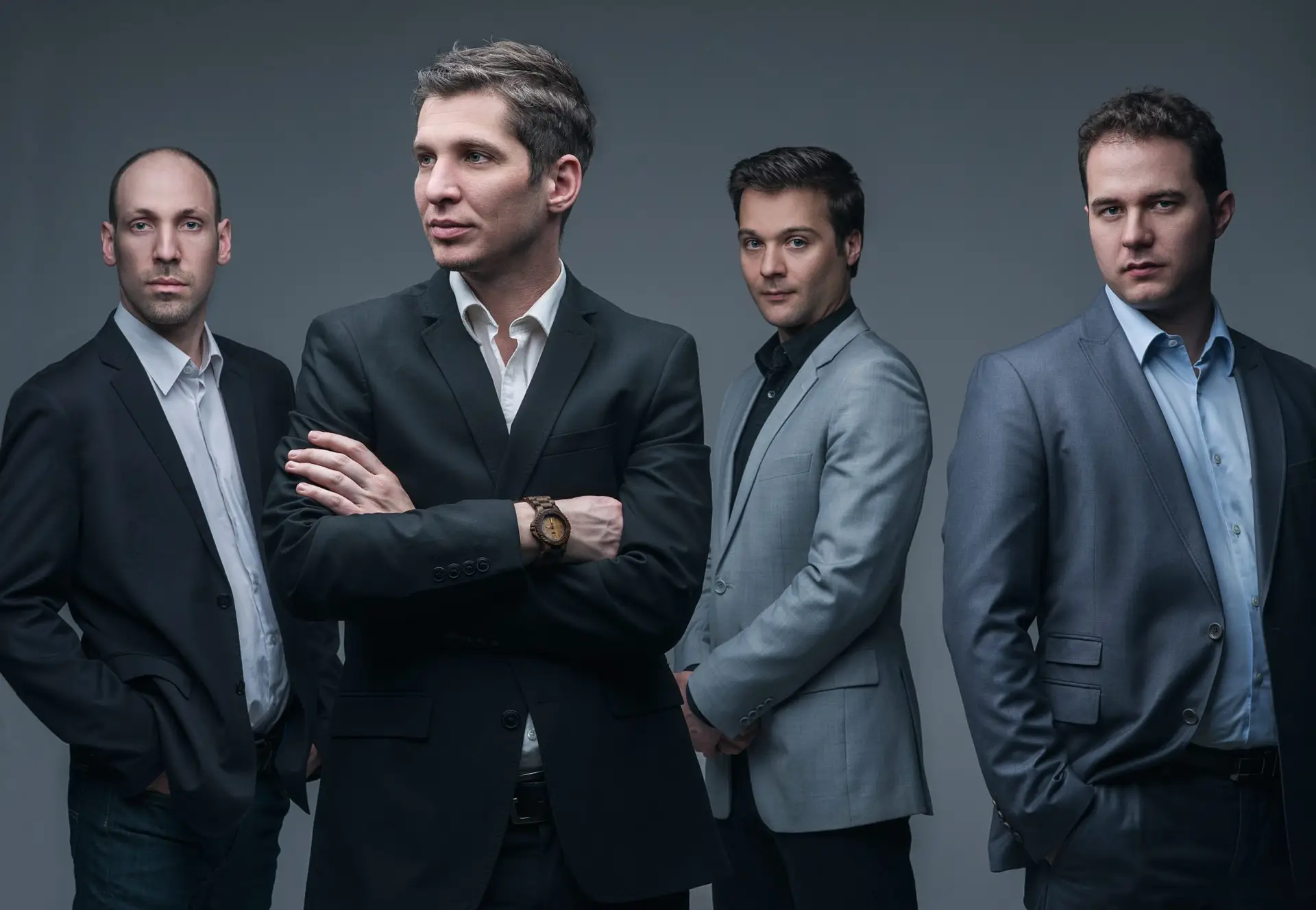
The Accord Quartet – Two Decades of Dedication
The Accord Quartet was founded in 2001 in Budapest, initiated by four young chamber musicians graduating from the Franz Liszt Academy of Music. Their founding goal is both simple and ambitious: to interpret the string quartet tradition in the language of their own time, with clarity and attention to the internal logic of the works. The name „Accord” refers not only to the harmony of musical chords but also to the accord among the musicians, which prevails through every challenge of the quartet repertoire. It is a particularly rare and outstanding achievement in chamber music that all four founding members remain active in the ensemble to this day.
On the Stages of Europe
Over the past two decades, the Accord Quartet has performed in nearly every country in Europe. They have been regular guests at prestigious venues such as the Centre for Fine Arts, Brussels (BOZAR), the Museo de Bellas Artes in Madrid, and the Hermitage in St. Petersburg, as well as festivals including Menton and Sintra, Ravenna Festival, Orlando Festival (Netherlands), Pont Royale, Santander Summer Festival, and the Kuressaare Festival. In these performances, they have always sought the essence of music: the delicate balance of form, tone, and rhythm that constitutes the quartet’s unique world. In April 2008, the ensemble performed for the Belgian Royal Family.
Giants of Chamber Music
In the course of their professional development, they received guidance from the greatest masters of the genre. Their training was led by such luminaries as the Amadeus Quartet, Alban Berg Quartet, Walter Levin (LaSalle Quartet), Rainer Schmidt (Hagen Quartet), and members of the Bartók Quartet.
With Heart and Immediacy
The quartet’s ars poetica is characterized by respect for humor, improvisational solutions, and the creation of the moment. „To play a wrong note is insignificant; to play without passion is inexcusable.” (Beethoven) This credo guides every performance, where the direct connection between instrument, music, and listener is paramount, thus creating a lasting experience.
Living Connection with Composers
The Accord Quartet is a key ensemble in Hungarian musical life, dedicated to the creation of new works. They have collaborated directly with composers such as John Corigliano, Kurt Schwertzig, Iván Erőd, Emil Petrovics, and Péter Eötvös. Composers who have written for or worked with them include Gyula Fekete, János Vajda, György Selmeczi, Miklós Csemiczky, László Vidovszky, Gyula Bánkövi, Zoltán Jeney, Péter Zombola, Máté Bella, Marcell Dargay, Árpád Kákonyi, and Zoltán Kovács. These works are the fruits of cooperation between the
Awards and Recognition
Junior Prima Prize (2010)
Johannes Brahms International Chamber Music Competition (1st Prize, Pörtschach, Austria, 2009)
Artisjus Prize (2006)
Leo Weiner National Competition (1st Prize)
Semmering Summer Academy Awards (Bartók, Kodály, and Thomastik-Infeld Prizes, Austria)
Ars Poetica
Heritage and Future – Thoughts by András Batta at the ensemble’s inception
„The string quartet is a social pastime. In its golden age, special tables were crafted so that when the top was lifted, music stands would rise up. The musical company would sit around this. ‘A conversation between four cultivated people’ – this was Goethe’s opinion of the genre some two hundred years ago. True, but in those days, our ancestors still had an ear for soft sounds, and the blaring, never-ending background music of today was nowhere to be heard.
Indeed, the string quartet represented a refined mode of social communication. A rather wide stratum of society understood this language. So much so that by the 19th century, with the appearance of concertizing quartets, hundreds and thousands bought tickets for the quartets of Mozart, Beethoven, and Brahms. This was the era when great quartet ensembles became traveling stars. Not a few of them started right here in Budapest, at the Academy of Music founded by Franz Liszt, where the heroes of this recording, these young musicians, also launch their careers. The Hubay-Popper, the Waldbauer-Kerpely, the Léner, the Magyar, the Végh, the Tátrai, and the Bartók Quartets carried the performance traditions of the Vienna-Budapest-Prague triangle far and wide. In many respects, they had an easier task than those of today. Back then, the string quartet was still part of living culture.
Today, it is more like a museum. Yet the fact that young people, such as the members of the Accord Quartet, feel the vocation and strength to devote their most receptive years to mastering the art of the professional string quartet is truly moving and thought-provoking. Musicians are still touched and fascinated by the high science and art of quartet playing. Why shouldn’t the modern listener share in this? Perhaps the very freshness and enthusiasm of youth can help achieve this—the renewing, thrilling sensation of discovery. After all, it is precisely young ensembles that are destined to preserve high culture against the tide of mass culture. Their mission will succeed if they find open and understanding ears.
In this hope, I recommend the Accord Quartet’s recording to the attention of those who believe in the immortality of the string quartet genre. For my part, I certainly count myself among them.”
Prof. Dr. András Batta
Széchenyi and Erkel Prize-winning music historian,
Managing Director of the House of Music Hungary, Professor Emeritus,
Rector of the Liszt Ferenc Academy of Music (at the time of writing)